Issue 324
Music Review
by Paul Matheson
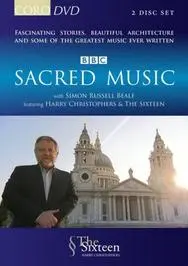
Sacred Music and the 500th anniversary of the birth of Palestrina: ‘Sacred Music’ featuring Harry Cristophers and The Sixteen, presented by Simon Russell Beale (Coro DVD, COR16078)
In the year ahead, across the world, we can expect a feast of concert performances, TV documentaries and new CD recordings of the music of the great Italian composer Palestrina, in celebration of his 500th anniversary.
Giovanni Pierluigi da Palestrina was born around 3 February 1525, not far from Rome, in the small town of Palestrina, whose name he took. Arguably the greatest composer of liturgical music of all time, Palestrina is often referred to as ‘The Prince of Music’ and described by some as ‘The Saviour of Church Music’. He had an enormous impact on the subsequent development of music. Hugely famous in his day, his reputation and influence grew even more following his death, and his work can be seen as a summation of Renaissance polyphony. His musical legacy is prodigious even by the standards of the time—he wrote over 100 masses—and he was the first Renaissance composer to have a complete edition of almost his whole output published in modern notation. For over 400 years, composers have studied and learned from Palestrina’s style of composing polyphony, his way of shaping the music.
Readers may remember watching the excellent BBC Four TV documentary series ‘Sacred Music’, broadcast in 2008. (’Sacred Music’ is no longer available to watch on BBC’s i-player but it is available on DVD from The Sixteen at thesixteenshop.com/products/sacred-music ). The series explores the development of western European sacred music from Gregorian Chant to Bach. It is presented by the likeable actor and former chorister Simon Russell Beale, and the music is sung by The Sixteen and expertly discussed by The Sixteen’s director Harry Christophers.
Episode two of the four-part series is devoted entirely to Palestrina. Much of it is filmed on location in Italy and Rome, including the great basilicas of St Peter’s, St Maria Maggiore and St John Lateran. We get insights about Palestrina from scholars and musicians, including Scotland’s own famous composer of sacred choral music, James MacMillan, who tells us that Palestrina’s music makes people think that they are in heaven, and that his music creates ‘a numinous opening in listeners’ hearts to whatever the divine may mean’.
We hear The Sixteen perform sections of Palestrina’s Missa Papae Marcelli (Mass for Pope Marcellus), which is regarded by many as the purest and most beautiful example of what sacred music should be. How did Palestrina come to write music that was so spiritually pure? Simon puts that question to music scholars, composers and choirmasters, and in the course of the programme we hear some fascinating answers, interspersed with sumptuous singing by The Sixteen.
We learn that Palestrina inherited from the great Franco-Flemish composer Josquin Des Prez a tradition of choral polyphony that was inspired by the soaring arches and acoustics of the medieval gothic cathedrals and basilicas. It is no coincidence that the arches of this music resemble the arches of cathedrals. We learn that Palestrina had a deep theological knowledge of the texts that he was commissioned to set to music, and he sought to express the text through the music.
Council of Trent
Palestrina’s musical education started as a boy chorister in the choir of St Maria Maggiore, the venerable 4th century basilica in Rome. As a young man he was church organist and composer back in his home town. After Palestrina’s local bishop became Pope Julius III in 1550, the new Pope made Palestrina the choirmaster of St Peter’s basilica in Rome.
After Josquin des Prez, sacred choral polyphony became more elaborate and sophisticated, with interweaving voices and overlapping parts and melodies. A consequence of that musical development was that the words of the polyphonically sung mass became harder to distinguish clearly. And that became problematic for the Church. When the Pope convened the third and final session of the Council of Trent (1545-1563) to progress the work of the Catholic Reformation and to counter Lutheran critiques of the Church, the problem of polyphony was on the agenda. The Council contemplated banning polyphony from church music altogether, which would have seen the sung Mass and holy offices revert back to Gregorian Chant.
In 1555, (at the midpoint of the Council of Trent) Pope Julius died and Pope Marcellus II was given the chair of St Peter. He was influenced by the deliberations of the Council and he made clear that he wanted intelligibility of the words in the sung Mass. So Palestrina undertook to deliver just that, and composed his hugely influential Mass for Pope Marcellus – Missa Papae Marcelli.
The documentary follows Simon Russell Beale into the sacred music archives in Rome and we see Simon open the original manuscript of Missa Papae Marcelli, written in Palestrina’s own hand. Simon and the Chief Archivist observe immediately that the musical notation looks strikingly different compared to the elaborate and sophisticated compositions of the period. The music looks simpler on the page because it gives one note to each syllable. It has a ‘homorhythmic’ texture, and yet it is still polyphony. Palestrina’s music can be sung comparatively more easily, and every single voice (soprano, alto, tenor bass) has its own clarity, dignity and melodic flow.
So, how does this apparently simpler music avoid sounding less engaging than the more elaborated compositions? Why does it sound more moving, more touching, more spiritual? Because Palestrina makes use of the natural rhythms of speech. He takes us back to the way we speak and gives a note to each syllable. But he does it like a poet, like Shakespeare, constructing the musical phrases with a natural, beautiful shape and flow. Like stained glass windows in a cathedral, Palestrina gives light and transparency to polyphony, so that the polyphony doesn’t suffocate the melody but exalts it.
To illustrate the point, Simon and The Sixteen let us hear Palestrina’s Latin motet for four voices Sicut Cervus (a setting of Psalm 42 ‘As the deep panteth for the water, so my soul it longs for Thee’). We hear clearly how Palestrina’s new polyphonic compositional style creates strong phrasing in soaring melodic arches that reflect Italian speech and melody. Prior to Palestrina, all the great composers at the Vatican had been from other countries. That changed with Palestrina. The balance, refinement, majesty and melodious polyphony of Palestrina’s compositional style started a great and long tradition of Italian composers of both sacred and secular music, paving the way for Monteverdi, Corelli, Vivaldi, Verdi and Puccini. That was Palestrina’s long-term influence.
In the short term, his new polyphonic style let us hear every word of sung scripture and sacred liturgy, while setting it to music so exquisite and so melodious that it expresses the human soul and spirit to the point of ecstasy.
Thus did Giovanni Pierluigi da Palestrina preserve sacred polyphony from its impending suppression by the Council of Trent and the new leadership of the Roman Catholic Church, the morally-austere Pope Paul IV, who succeeded the short-lived Pope Marcellus. Ironically, it was Paul IV’s uncompromising moral rigour that led to Palestrina being dismissed from his post on the grounds that – as a married man with children – Palestrina did not meet the celibacy rule of the Cappella Sistina: a rule that Pope Julius III had waived in order to bring a great Italian composer and choirmaster to St Peter’s.
As compensation, Palestrina was given the post of Director of Music at another of the great and ancient Roman basilicas, St John Lateran. In another irony, that was where Palestrina composed Sicut Cervus, his pure and dignified setting of Psalm 42 in which the words are so clear that even amateur singers like me can try to join in. In our own day, Sicut Cervus is still sung as part of regular church worship all over the world. I often hear it sung at Glasgow’s St Aloysius Church at their Sunday Sung Mass at noon, and invariably I weep at its tender simplicity and the sheer beauty of it. When the austere Pope Paul IV first heard Palestrina’s Sicut Cervus, did he weep, I wonder? I like to think he did.
Paul Matheson is a diversity officer with the police.