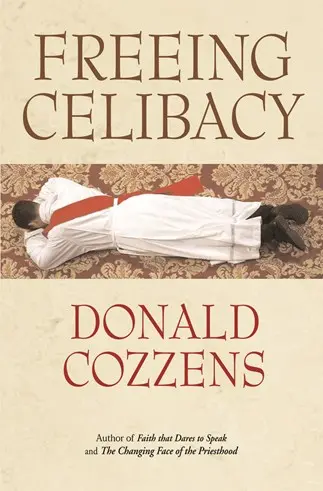
Freeing Celibacy
by Joe Fitzpatrick
Donald Cozzens, Freeing Celibacy, Liturgical Press 2006.
One of the issues for discernment at the forthcoming Synod in Rome will be the ordination of married men. Donald Cozzen’s 2006 book, Freeing Celibacy, was widely acclaimed in the US and elsewhere, not least by several bishops, and is worth revisiting today.
At the time of its publication, Cozzens had been a priest for more than 40 years. He was also a psychologist, a theologian, and a former seminary rector and professor. The argument in this book is quite straightforward but comprehensive in terms of its potential impact on Catholic life. The author distinguishes between celibacy as a ‘charism’ or gift to the Church and celibacy as mandated as a legal precondition for the ordination of Catholic priests in the Western Latin rite. He strongly defends the former and equally strongly argues that celibacy as mandated or legally binding on Catholic diocesan priests should be abolished.
The reason, he points out, is that those for whom celibacy is a charism or gift from God find that it fits or suits their personalities, temperaments, mission and lifestyles whereas mandatory celibacy for many others has been ‘an unnecessary, unnatural and unhealthy burden that has shrunk their souls and drained the last drop of passion from their lives’. In short, he argues powerfully that you cannot mandate a charism. He quotes a scholarly friend as saying that for many priests, mandatory celibacy ‘is like trying to train people to be ballerinas who can’t dance the two-step.’
The book is only 115 pages long, consists of nine fairly short chapters and an impressive bibliography and is supported by wide reading and a very shrewd understanding of the situation of the Catholic Church in the USA, which is strikingly like the situation in the UK and the rest of Western Europe. It draws attention to the scandal of the sexual abuse of minors by some priests and religious. A previous book by Cozzens titled The Changing Face of the Priesthood had been acknowledged by US bishops as raising valid, real issues but, some said, issues that should not have been raised by ‘a sitting rector’. Cozzens understandably defends his discussion of ‘thorny, troubling issues’ on the grounds that these issues ‘should no longer, could no longer, be denied’.
Debunking
One of the most important merits of the book is its debunking of the widely shared belief that the Church in the West has always embraced clerical celibacy. As he writes, ‘For more than half of its two thousand year history... priests were free to marry’. In the early Christian centuries, popes, bishops and priests married and had children. The son of a priest became Pope Sixtus (116 - 125) and Pope St. Anastasias 1 (399 – 401) was succeeded by his son, Pope St. Innocent 1 (401 – 417). The great pope and Doctor of the Church of the late sixth century, Gregory 1, was the great-grandson of Pope Felix III and great-great great-great-grandson of Pope Felix II. About a dozen popes in the first millennium were the sons of priests. Not a few were canonised saints. Cozzens asks why ‘The feast days of these married saints and popes remain off the General Roman Calendar’ and suggests that ‘the reason for the omission (could be) that public recognition of their saintly, married lives might further the cause of optional celibacy’.
Cozzens is aware of the administrative advantages of celibacy, noting how ‘changing the assignment of celibate priests... is far less complicated than moving a married priest from one parish to another. There is no wife to consult, no changing of schools for children, and mostly no mortgage to be negotiated. The same relative ease accompanies the move of a bishop from one diocese to another’. But, as he observes, the price paid for this administrative advantage might run counter to the priest’s power to preach, teach and inspire since it so easily leads to clericalism, ‘the bane of Western, non-married clergy’ who too often see their role as exercising power over their parishioners.
As a psychologist, Cozzens also links mandatory celibacy with the scandal of the sexual abuse of minors by some priests and religious. He writes, ‘Often fixated in their psychosexual development at the adolescent stage, their sexual interest mirrors their arrested maturation. These priests find themselves drawn to attractive teenagers. The dangers associated with such truncated emotional and sexual maturation have been made painfully clear with the sexual abuse scandals that erupted in the last decades of the 20th century.’
Donald Cozzens, who died in 2021 aged 82, sums up his argument in the last short paragraph: ‘Charismatic celibacy...is indeed a blessing for the church. As a freely bestowed gift of the Spirit, it deserves to be released from canonical mandate as a condition for ordination. The time has come to set celibacy free.’
Joe Fitzpatrick is a writer and former Inspector of Schools.