Issue 324
The Afternoon of Christianity
by Mary Cullen
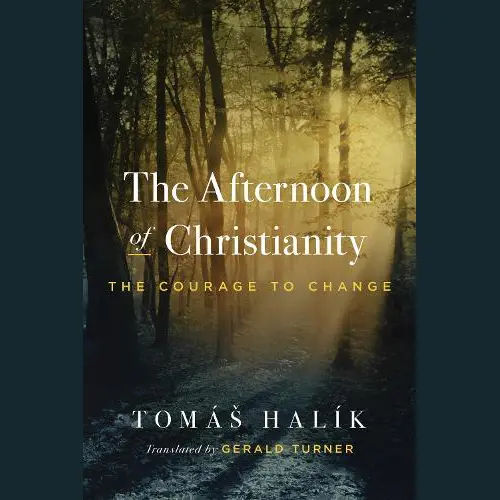
Tomás Halík, The Afternoon of Christianity: the courage to change. University of Notre Dame Press, 2024. Translated by Gerald Turner.
This is a book about faith as a journey in search of God in the midst of a changing world. Christ came not to offer a ’doctrine’ but a journey on which we continually learn to transform our humanity, our way of being human and all our relationships – to ourselves, to others, to society, to nature and to God (p.132).
Tomás Halík is uniquely qualified to map out the journey. A clinical psychologist, Catholic priest, philosopher, pastor and theologian, he is also a professor of sociology at the University of Prague and president of the Czech Christian Academy. He was ordained in the underground church before the fall of Communism and draws deeply on his experience and scholarship to explore the Church’s present crisis and identify emerging signs of change.
The afternoon of the book’s title comes from Carl Jung’s metaphor for the dynamics of human life: childhood is the morning of life, followed by the midday crisis and the afternoon age of maturity. In the history of Christianity, the morning is the premodern period of building the Church’s institutional and doctrinal structures. Then comes the age of modernity, of secularisation, of shaking up the structures. The postmodern age in which we now live is a call to afternoon Christianity, to greater maturity and depth.
Today, as at every period of significant historical change, Halík argues, the position and role of faith in society and the forms of its cultural self expression are changing. He traces the history of Christianity and its roots in Judaism, the relationships between faith, religion, and culture. The Christian faith has outgrown its previous forms, he concludes, and every attempt to squeeze it back into one of them is counterproductive.
He highlights the unfinished business of the Second Vatican Council, which attempted to reach an understanding with modernity and move the Church from its narrow confessional form towards an ecumenical, global Christianity. As he points out, modernity was already on its way out and the move came too late; the Church’s attempt to achieve unity among Christians, dialogue with other religions and rapprochement with secular humanism never got more than half way. Continuing on this path, he argues, remains a task for the afternoon of Christianity (p.54).
He believes that we are at a Kairos moment, an opportunity to transform the way we think and act. It is no coincidence, he says, that someone who represents the dynamics of the Latin American continent has become pope. (The book is dedicated to Pope Francis ‘with reverence and gratitude’). Halík considers it an ‘urgent task’ for theologians carefully to elaborate Francis’ reformist impulses in the development of synodality and autonomy of local churches. However, he asks if bishops are ready to give up their monarchical conception of their role and become mediators of dialogue within the church. Are they sufficiently prepared to create and defend scope for the exercise of the charisms of individual believers, men and women? Are they ready to recognise the capacity of believers to share responsibility for communities? The reform of the church, he argues, is about more than changes to institutional structures. It must come from deep spiritual renewal (p.91).
Spirituality
Halík points out that while traditional institutional forms of religion often resemble ‘dried up riverbeds’, interest in spirituality of all kinds is a ‘surging current that is eroding old banks and carving out new channels’. He suggests that the future of churches depends largely on whether, when and to what extent they understand the importance of this shift and how they respond to this sign of the times. Christianity’s task in the afternoon of its history will largely be about the development of spirituality (p.152).
The institutions of the Church ’no longer have the power to control and discipline faith’. But ‘the church as a community of believers, of memory, narrative and celebration has an enduring mission to serve the faith by its historical experience and, above all, by the power of the Spirit who dwells and works even within clay jars’ (p 184).
He identifies four ecclesiological concepts that can help shape this church. First is the concept of the Church as the people of God journeying through history, which was a central element of Vatican II’s ecclesiology. Second, the Church as a school of life and wisdom, where the virtues of faith, hope and love are at the centre of the curriculum. Third, the Church as field hospital, about which Pope Francis has spoken; a church which does not remain behind the walls of certitudes but goes to out to heal wounds and minister to people. Fourth, the Church as a place of encounter and conversation, which offers a ministry of accompaniment and reconciliation. This would involve the creation of spiritual centres; places of adoration and contemplation, where experiences of faith can be shared. If the Church is not to become a self contained sect, Halík argues, it must undertake a ‘radical shift in its self-conception, in its understanding of its service to God and to people in this world’ (p.195).
This ministry of spiritual accompaniment straddles the boundary between the religious and secular spheres; it draws on the spiritual treasures of religion but it lives in a secular space, so it must express itself in a way that is widely understood. Like public theology, it must ‘transcend the boundaries of the church’s language game’ (p.202).
This is an important book from a highly respected author who won the Templeton Prize in 2014 in recognition of his outstanding contributions to theology and his efforts to facilitate interfaith dialogue. In the final paragraph, he reminds us that a new day begins at evening. Let’s not miss the moment, he suggests, when the first star appears in the evening sky.
Dr Mary Cullen is editor of Open House.